
Hello friends! Today we talk about a very famous math rule called Pythagoras Theorem. This theorem is super old, like thousands of years old, and it was made by a man named Pythagoras from Greece. He was a smart guy who loved math. This theorem is used in triangles, but not any triangle, only special ones called right-angled triangles. If you study math in school or need to solve problems about triangles, this theorem is like your best friend! Let’s learn it in simple way.
Definition
Okay, so what is Pythagoras Theorem? the definition is:
In a right-angled triangle, the square of the length of the hypotenuse is equal to the sum of the squares of the lengths of the other two sides.

A right-angled triangle is a triangle where one angle is 90 degrees (like a corner of a square). This theorem tells us how the sides of this triangle are connected. The sides have special names:
- Hypotenuse: This is the longest side, opposite to the 90-degree angle.
- Base and Perpendicular: The other two sides that make the right angle.
The theorem says: If you take the length of the two shorter sides, square them, and add them, it will equal the square of the longest side (hypotenuse). Simple?
Formula
Now, let’s see the formula. It’s very easy to remember:
a² + b² = c²
Here:
- a and b are the lengths of the two shorter sides (base and perpendicular).
- c is the length of the hypotenuse (longest side).
For example, if you know the length of two sides, you can find the third side by using this formula. Just put the numbers in, and you’re done!
Examples
Let’s do some examples to make it super clear. These are like real problems you solve in school.
Example 1: Finding the Hypotenuse
Suppose a right-angled triangle has:
- Base (a) = 3 cm
- Perpendicular (b) = 4 cm
- Hypotenuse (c) = ?
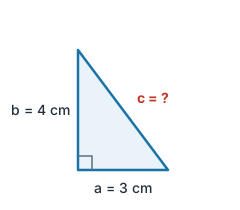
Using Pythagoras Theorem:
| Step | Value | Description |
|---|---|---|
| Step 1 | a² + b² = c² | Start with the theorem |
| Step 2 | 3² + 4² = c² | Put in the values you know |
| Step 3 | 9 + 16 = c² | Work out the squares |
| Step 4 | 25 = c² | Add them together |
| Step 5 | c = √25 = 5 cm | Take the square root of both sides |
The hypotenuse is 5 cm. Easy, right?
Want more worked examples of this exact case? See how to find the hypotenuse of a right triangle.
Example 2: Finding a Side
Now, let’s say you know:
- Hypotenuse (c) = 10 cm
- Base (a) = 6 cm
- Perpendicular (b) = ?
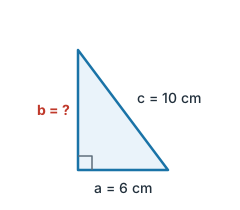
Using the formula:
| Step | Value | Description |
|---|---|---|
| Step 1 | a² + b² = c² | Start with the theorem |
| Step 2 | 6² + b² = 10² | Put in the values you know |
| Step 3 | 36 + b² = 100 | Work out the squares |
| Step 4 | b² = 100 − 36 = 64 | Take 36 off both sides |
| Step 5 | b = √64 = 8 cm | Take the square root of both sides |
The perpendicular is 8 cm. See, it’s like a game!
The same method works for any missing side — see how to find the missing side of a right triangle.
Conclusion
So, friends, Pythagoras Theorem is a super useful rule for right-angled triangles. It helps us find the length of a side if we know the other two sides. The formula a² + b² = c² is simple and works every time. Whether you’re doing homework, building something, or even playing games with math, this theorem is always there to help. So, next time you see a right-angled triangle, just remember Pythagoras and his cool rule! Keep practicing, and you’ll become a pro in no time.
