The hypotenuse is the longest side of a right-angled triangle, sitting directly opposite the 90° corner. If you know the other two sides, you can always work it out — no measuring needed. This guide shows how to find the hypotenuse step by step, with the formula and several worked examples including one that does not give a whole number.
Which Side is the Hypotenuse?
- Base (a) — one side of the right angle
- Height (b) — the other side of the right angle
- Hypotenuse (c) — opposite the right angle
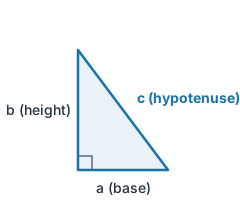
The hypotenuse is always the longest of the three sides. If your answer comes out smaller than one of the other sides, something has gone wrong.
Formula for the Hypotenuse
Start from the Pythagoras Theorem and take the square root of both sides:
c = √(a² + b²)
Steps to Find the Hypotenuse
- Write down the two known sides, a and b.
- Square each of them.
- Add the two squares together.
- Take the square root of the total. That is your hypotenuse.
Examples
Example 1: Sides 6 cm and 8 cm
Using the formula:
| Step | Value | Description |
|---|---|---|
| Step 1 | c = √(a² + b²) | Start with the formula |
| Step 2 | c = √(6² + 8²) | Put in the values you know |
| Step 3 | c = √(36 + 64) | Work out the squares |
| Step 4 | c = √100 | Add them together |
| Step 5 | c = 10 cm | Take the square root |
The hypotenuse is 10 cm.
Example 2: Sides 5 m and 12 m
Using the formula:
| Step | Value | Description |
|---|---|---|
| Step 1 | c = √(a² + b²) | Start with the formula |
| Step 2 | c = √(5² + 12²) | Put in the values you know |
| Step 3 | c = √(25 + 144) | Work out the squares |
| Step 4 | c = √169 | Add them together |
| Step 5 | c = 13 m | Take the square root |
The hypotenuse is 13 m.
Example 3: When the Answer is Not a Whole Number
Sides 7 cm and 9 cm:
| Step | Value | Description |
|---|---|---|
| Step 1 | c = √(a² + b²) | Start with the formula |
| Step 2 | c = √(7² + 9²) | Put in the values you know |
| Step 3 | c = √(49 + 81) | Work out the squares |
| Step 4 | c = √130 | Add them together |
| Step 5 | c ≈ 11.40 cm | Square root, rounded to 2 decimals |
The hypotenuse is about 11.40 cm.
The Shortcut: Spot a Known Triple
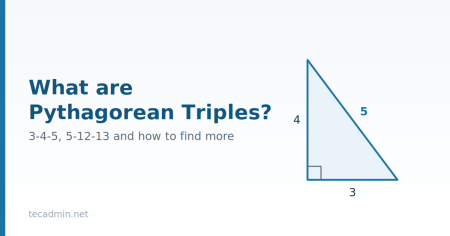
Examples 1 and 2 never really needed a calculator. 6-8-10 is just 3-4-5 doubled, and 5-12-13 is a triple on its own.
| If you see | Hypotenuse is | Why |
|---|---|---|
| 3 and 4 | 5 | Basic 3-4-5 triple |
| 6 and 8 | 10 | 3-4-5 doubled |
| 9 and 12 | 15 | 3-4-5 tripled |
| 5 and 12 | 13 | 5-12-13 triple |
| 8 and 15 | 17 | 8-15-17 triple |
Learning a handful of Pythagorean Triples lets you answer many questions in seconds.
Mistakes to Avoid
- Do not add first and square after. √(6 + 8)² is not the same as √(6² + 8²).
- This formula only works on right-angled triangles.
- Both sides must use the same unit before you start.
If you are given the hypotenuse and need one of the shorter sides instead, the method changes slightly — see how to find the missing side of a right triangle.
Conclusion
To find the hypotenuse, square both known sides, add them, and take the square root: c = √(a² + b²). Check your answer is the largest of the three sides, keep your units consistent, and watch for a familiar triple that saves you the calculation entirely.