
In a right-angled triangle, knowing any two sides is enough to work out the third. But the method changes depending on which side is missing. If the hypotenuse is missing you add; if a shorter side is missing you subtract. Getting that one detail right is the whole skill, and this guide walks through both cases.
First, Identify What is Missing
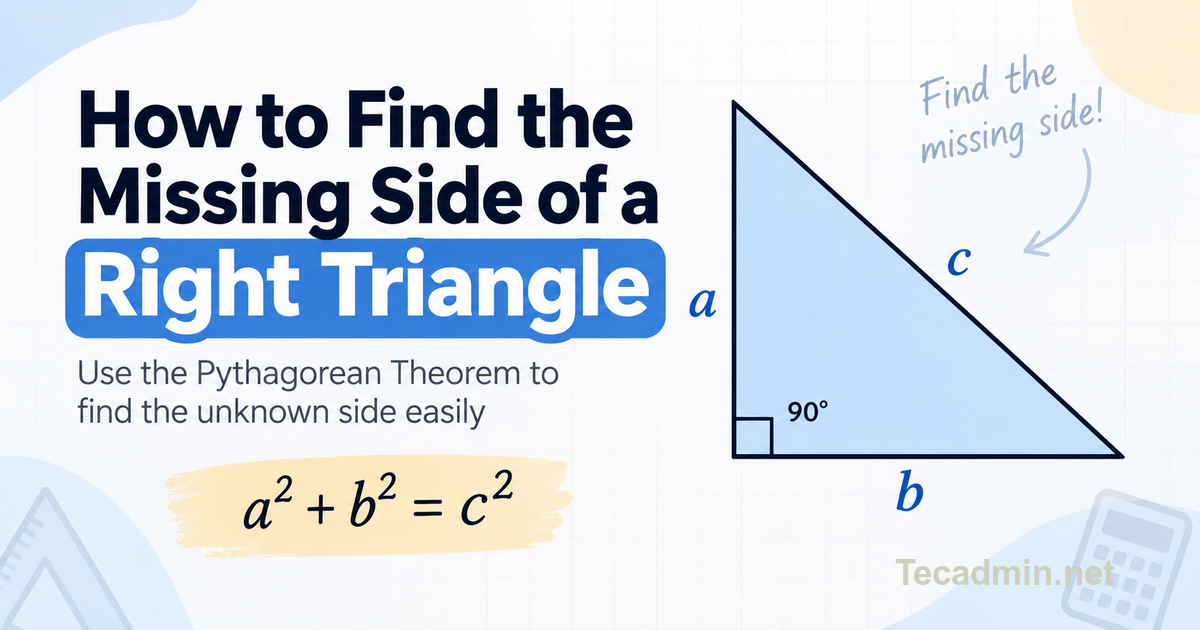
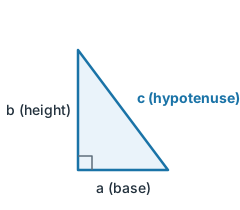
- a and b — the two legs, forming the right angle
- c — the hypotenuse, opposite the right angle
- c is always the longest side
| Missing side | Formula | Operation |
|---|---|---|
| Hypotenuse (c) | c = √(a² + b²) | Add the squares |
| Leg (a) | a = √(c² − b²) | Subtract the squares |
| Leg (b) | b = √(c² − a²) | Subtract the squares |
Steps
- Label the sides. Find the hypotenuse first — it is opposite the right angle.
- Decide whether the missing side is the hypotenuse or a leg.
- Pick the matching formula from the table above.
- Square the two known values, then add or subtract as required.
- Take the square root to get your answer.
Case 1: Finding a Missing Leg
Example 1: Hypotenuse 10 cm, one leg 6 cm
The missing side is a leg, so subtract:
| Step | Value | Description |
|---|---|---|
| Step 1 | b = √(c² − a²) | Formula for a missing leg |
| Step 2 | b = √(10² − 6²) | Put in the values you know |
| Step 3 | b = √(100 − 36) | Work out the squares |
| Step 4 | b = √64 | Subtract |
| Step 5 | b = 8 cm | Take the square root |
The missing leg is 8 cm.
Example 2: Hypotenuse 13 m, one leg 5 m
Again the missing side is a leg:
| Step | Value | Description |
|---|---|---|
| Step 1 | a = √(c² − b²) | Formula for a missing leg |
| Step 2 | a = √(13² − 5²) | Put in the values you know |
| Step 3 | a = √(169 − 25) | Work out the squares |
| Step 4 | a = √144 | Subtract |
| Step 5 | a = 12 m | Take the square root |
The missing leg is 12 m.
Case 2: Finding the Missing Hypotenuse
Example 3: Legs 9 cm and 12 cm
The missing side is the hypotenuse, so add:
| Step | Value | Description |
|---|---|---|
| Step 1 | c = √(a² + b²) | Formula for a missing hypotenuse |
| Step 2 | c = √(9² + 12²) | Put in the values you know |
| Step 3 | c = √(81 + 144) | Work out the squares |
| Step 4 | c = √225 | Add |
| Step 5 | c = 15 cm | Take the square root |
The hypotenuse is 15 cm.
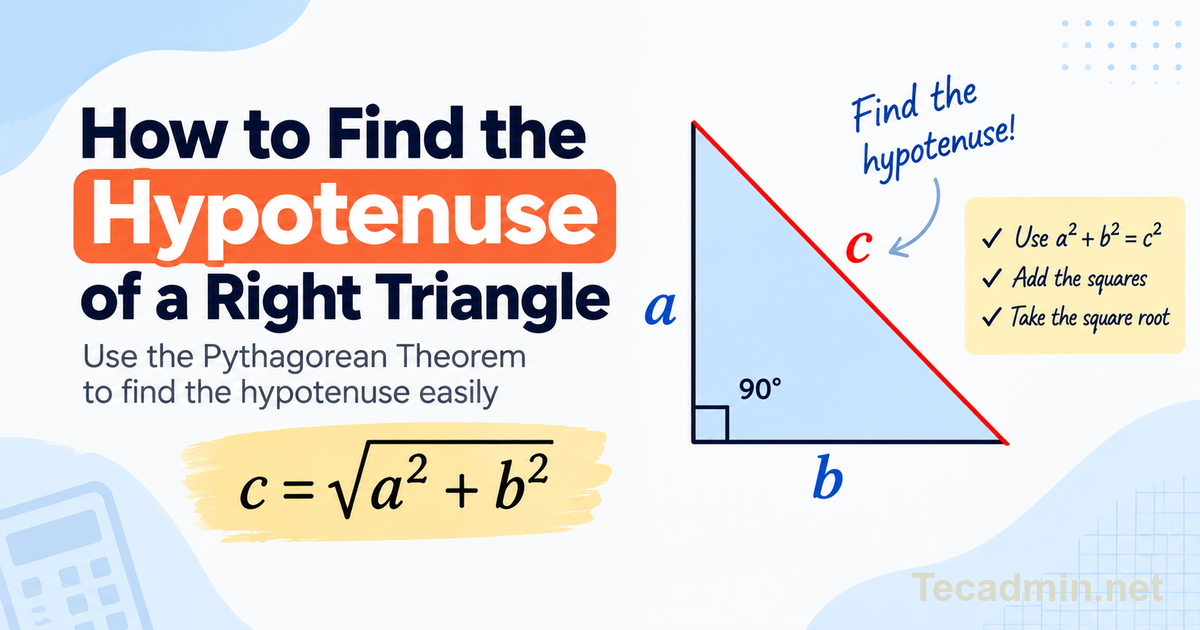
Full detail on this case, including decimal answers, is in how to find the hypotenuse of a right triangle.
A Real-Life Problem
Example 4: The Ladder Problem
A 5 m ladder leans against a wall. Its foot is 3 m from the wall. How high up does it reach?
The ladder is the hypotenuse, the wall height is the missing leg:
| Step | Value | Description |
|---|---|---|
| Step 1 | b = √(c² − a²) | Wall height is a leg |
| Step 2 | b = √(5² − 3²) | Ladder 5 m, distance 3 m |
| Step 3 | b = √(25 − 9) | Work out the squares |
| Step 4 | b = √16 | Subtract |
| Step 5 | b = 4 m | Take the square root |
The ladder reaches 4 m up the wall.
Mistakes to Avoid
- Subtracting the wrong way round. Always take the smaller square away from the bigger one. A negative number under the root means you mixed up the hypotenuse.
- Adding when you should subtract. If a known side is the longest, you must subtract.
- Forgetting the square root at the end. b² = 64 is not the answer; b = 8 is.
- Mixed units. Convert everything to cm or m before starting.
Conclusion
Finding a missing side comes down to one decision: is the missing side the hypotenuse or a leg? Add the squares for a hypotenuse, subtract them for a leg, then take the square root either way. Check that the hypotenuse is still the longest side when you finish, and the answer will be right every time.
How did it make you feel?