
Node.js is an open-source JavaScript runtime environment. It allows to run JavaScript outside a web browser. This tutorial will help you to install Node.js on your Windows system. Installing Node on Windows Following are the steps to install Node on Windows system. Download Node.js Installer You can downlod the Node Windows installer from its official download page. Download the installer as per your system architecture. Run Installer Once the installed downloaded, double click on installer file to begin the installation process. Click Next to continue installer. Next, accept the terms of license agreement and click next to continue installation. Complete…
Author: Rahul

Rahul
I, Rahul Kumar am the founder and chief editor of TecAdmin.net. I am a Red Hat Certified Engineer (RHCE) and working as an IT professional since 2009..
Read More
In the dynamic world of software development, managing multiple projects often means juggling different versions of Node.js. This is where the .nvmrc file becomes a lifesaver. It’s a simple yet powerful tool for ensuring that each of your projects uses the right Node.js version automatically. In this guide, we’ll walk you through the process of creating and utilizing a .nvmrc file for seamless Node version management. What is a .nvmrc File? The .nvmrc file is a configuration file for Node Version Manager (NVM), a popular tool used to install and manage multiple Node.js versions. By placing a .nvmrc file in…
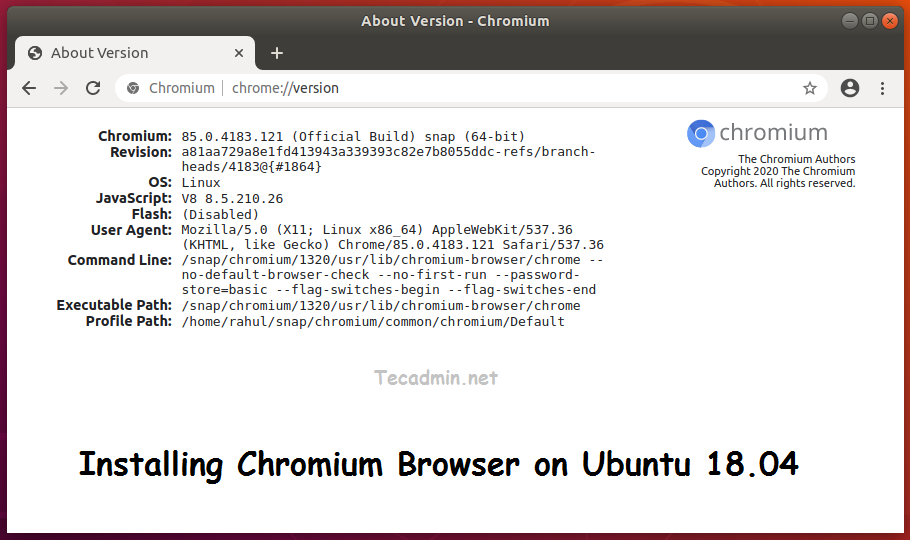
Chromium is an open-source web browser project that aims to build a safer, faster, and more stable way to its users for a better experience of the web. Chromium is perfectly safe for using. Make sure to download it from a good source or official Google download page. Also make sure to update it on regular basis. This tutorial will help you to install chromium web browser on Ubuntu 18.04 LTS Linux system. Installing Chromium on Ubuntu The Ubuntu 18.04 operating systems contains chromium browser under the default package repositories. It also available as Snap package for Ubuntu systems Its…
Angular is the most popular framework used to build mobile and web applications. Angular is an open-source web application framework developed by Google an a large community of individuals. As of today, Angular 10 is the latest version available for the installation. This tutorial will help you to install Angular CLI node module on your Ubuntu 20.04 Linux system. Step 1 – Installing Node.js NVM is a command line tool for installing and managing node.js on Linux system. So first we need to install nvm on our system. Login to system with user for which you need to install Node.js,…
This is a good idea to create separate branches in git repository for a new features. In that scenario, don’t forgot to keep your feature branch up to date from master branch. So update your feature branch on a regular interval to avoid any merge conflicts. This tutorial will help you to update your feature branch from parent branch. We assume your parent branch is ‘master’. Execute following command to rebase your feature branch with master branch. git checkout master git pull git checkout – git rebase master The above commands do the followings. Checkout the master branch and switch…
In the ever-evolving landscape of software development, efficiency and automation stand as pillars of success. Jenkins, an open-source automation server, enables developers to automate the various aspects of software development related to building, testing, and deploying, facilitating a more streamlined development process. This guide will walk you through the comprehensive steps to install Jenkins on Ubuntu, a popular choice for many development and production environments due to its stability, security, and ease of use. Prerequisites Before we dive into the installation process, ensure you have the following prerequisites covered: An Ubuntu server (we recommend using the latest LTS version for…
The LIKE statement is used for searching records with partial strings in MySQL. By default the query with LIKE matches case-insensitive recores. Means query will match both records in lowercase or uppercase. For example, Search all records un colors table where name is start with “Gr”.
1 | mysql> SELECT name FROM colors WHERE name LIKE 'Gr%'; |
You can see the above query matches records with any cases. But, sometimes you need to select case-sensitive data only. In that case, You need to cast the values as binary. To do this add BINARY option with like statment and view the results:
1 | mysql> SELECT name FROM colors WHERE name LIKE BINARY 'Gr%'; |
You can see the result contains only those…
The AWS CLI is a tool you use in the command line (terminal) to work with Amazon Web Services (AWS). It helps you manage and automate AWS services without needing a web browser or extra apps. In this guide, we will learn how to install AWS CLI v2 on a Linux system. You can find the official AWS CLI documentation here. For general usage information, you can read this guide. Step 1: Installing AWS CLI on Linux The AWS CLI version 2 can be installed from the default repositories on Linux. You can use a package manager to install it.…

The Certbot is a command-line utility for getting free SSL certificates from the Let’s Encrypt certificate authority. It allows you to request a new SSL certificate, do the authorization and configure your web server for SSL settings. You can also obtain SSL certificates for other services like Mail servers, proxy, and VPN servers. This tutorial helps you to install the Let’s Encrypt client on CentOS 8 Linux system. Prerequisites Before installing Certbot on CentOS 8, You must fulfill: A CentOS 8 Linux system with sudo user access. Apache (HTTP) web server with virtual host configured with a domain. Domain or…
Python provide multiple functions to generate random numbers. Most of these functions are available under the Python random module. You can use these functions for generating random numbers in your Python scripts. Here is the five main functions used for generating random numbers in a Python script. random() randint() uniform() randrange() choice() 1. Python random() function: This function returns a random floating point value between 0 to 1. You can also specify the range to override the defaults.
1 2 3 4 5 6 7 8 9 10 11 12 13 | import random # Print a random float number between 0 and 1 x = random.random() print (x) # Print a random float number between 0 and 10 x = random.random() * 10 print (x) # Print a random float number between -5 and +5 x = random.random() * 10 - 5 print (x) |
2. Python randint() function: The randint() function takes in a range and produces an integer number between the defined range.
1 2 3 4 5 | import random # Print a random integer between 10 and 100 x = random.randint(10, 100) print (x) |
…