
Hey there! If you’re using Linux—whether it’s on a server, your laptop, or some random project—you’ve probably noticed it can slow down sometimes. Usually, that’s because a few processes are hogging the CPU. Figuring out what they are and getting them under control can make a huge difference. So, let’s walk through how to spot the top 10 CPU-heavy processes and what you can do about them. Trust me, it’s easier than it sounds! Here is the quick command to find CPU-intensive processes: ps -eo pid,ppid,cmd,%cpu –sort=-%cpu | head -n 11 Why Bother Checking CPU Usage? Picture this: your system’s…
Author: Rahul

Rahul
I, Rahul Kumar am the founder and chief editor of TecAdmin.net. I am a Red Hat Certified Engineer (RHCE) and working as an IT professional since 2009..
Read More
The APT cache stores downloaded package files on your system. Over time, this cache can take up significant disk space. How do you clear the apt cache? You simply use this apt clean command option: apt clean Clearing the APT cache is a simple way to free up space while keeping your system running smoothly. Clear Apache Cache: Step by Step Guide Step 1: Check Disk Space Usage Before clearing the APT cache, check how much disk space is currently used by the cache. Open a terminal and execute the following command: sudo du -sh /var/cache/apt This will show the…
I am working on a AI model that have a few files larger than 10MiB of trained model. While pushing those models to huggingface repository I got an error saying the files are too large to upload. Hugging Face has a size limit for single files, and files larger than 10MiB need special handling. This means I need to change the way I upload or store these files. This article will help you understand why this error happens and how you can fix it. You will learn how to push large files to a Hugging Face repository step by step.…
Today, I found a file on my server named -config.ini that starts with a hyphen. It seems someone created it as a backup. The problem is, the starting hyphen is treated as a command-line option, making it tricky to delete. If you’re facing the same issue, don’t worry—this guide will show you how to remove it safely. Files with a “-” at the beginning of their name can be removed using the rm command with additional care since the – is interpreted as an option by most Unix commands. Delete file name begin with hyphen Here’s how you can safely…
It is important to know which NVIDIA driver version is installed on your Linux system for compatibility with your hardware and software. The driver version ensures your graphics card works properly and supports the applications you use. Knowing the version also helps when updating or troubleshooting. You can check the installed version using commands like nvidia-smi or by checking system settings in your Linux distribution. This tutorial will help you understand how to check the NVIDIA driver version on your Linux system. It will guide you step-by-step using simple commands and tools. Check NVIDIA Driver Version on Linux Choose one…
If you’re a Linux user, and you use distros such as Ubuntu or Debian, then you will have surely seen the command apt update. But what is it, exactly, and why do you want to run it often? In this article, we are going to break down the apt update command into simple words and explain what role it has in keeping your system running as it should. What is apt? APT is an acronym for Advanced Package Tool, and it is a command-line utility that allows us to handle software packages in Debian-based Linux distributions such as Ubuntu. An…
When you use Linux, especially Ubuntu or other Debian-based systems, you may notice that over the time your systems disk filled with many unnecessary files. These files can take up space and make your system feel cluttered. Don’t worry, the Apt package manager provides a simple command apt autoremove, that can help you clean your system easily. In this guide, we will explain what it does, why you need it, and how to use it with clear step by step instructions. What is apt autoremove? When you install or update software on Linux, some extra files and packages (called dependencies)…
Git push is a regular process used by developers to send changes to a remote repository. Recently, I noticed that I committed a few unnecessary files and pushed them to the remote Git repository. These files were not required and should have been excluded. To fix this, I plan to remove them from the repository and update the .gitignore file to avoid pushing such files in the future. To delete the last pushed commit, you can follow these steps. Make sure you understand the implications of rewriting commit history, especially if working in a shared repository. Steps to Delete the…
PHP is a popular programming language widely used by developers for creating dynamic and robust web applications. It is known for its simplicity, flexibility, and extensive support for modern frameworks and libraries. Most of the popular CMS applications (eg: WordPress, Drupal etc.) are still using PHP programming language. As of today, the latest PHP version is 8.4, recommended for use in production environments. REMI is an one of the most trusted RPM repository that provides PHP versions ranging from 7.4 to 8.4. Using this repository, you can easily manage and install multiple PHP versions on your system. This tutorial will…
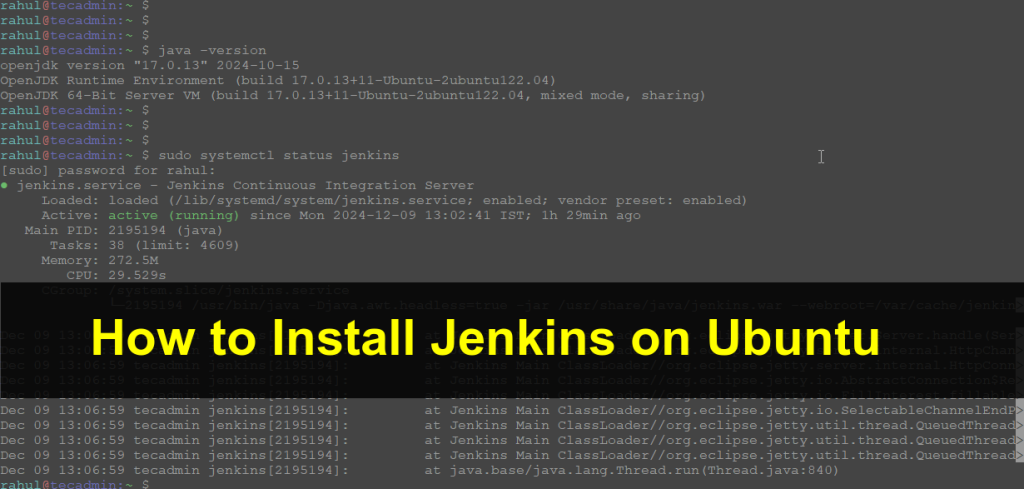
Mostly every programmer following a software development life cycle that helps them to keep track of the application. A development life cycle have there own challenges and one of them is to build, test and deploy application. Jenkins is an automation server for the continuous integration tool. It provides a number of plugins for building and deploying your application in an easier way. You can use Jenkins as a simple CI (Continuous Integration) server or configure this for the CD (Continuous Delivery) hub for any number of the projects. With the help of Jenkins, you can easily distribute work across…