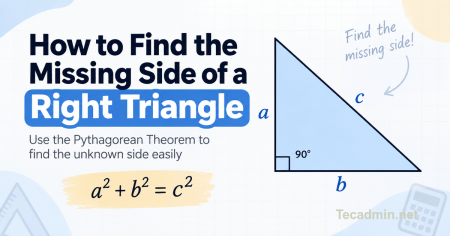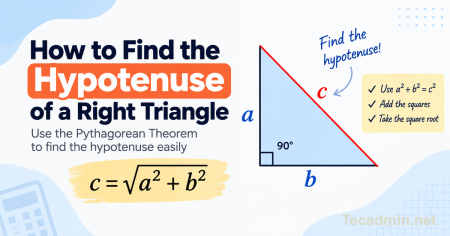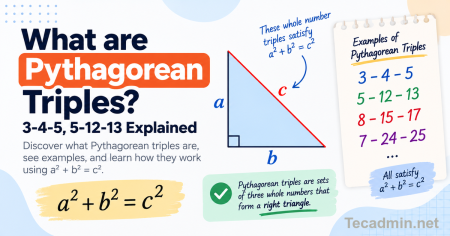
The Pythagoras Theorem starts with a right-angled triangle and tells you about its sides. The converse of Pythagoras Theorem works backwards: it starts with three side lengths and tells you whether the triangle has a right angle at all. It is a simple idea, but a very useful one — it is how builders check that a wall corner is truly square without using any instrument.
What is the Converse of Pythagoras Theorem?
If the square of the longest side of a triangle equals the sum of the squares of the other two sides, then the triangle is a right-angled triangle, and the right angle is opposite the longest side.
So if you measure three sides and find that a² + b² = c², you can be certain the angle facing side c is exactly 90°.
Theorem vs Converse: What is the Difference?
Students mix these up all the time. The difference is only the direction — what you are given, and what you find out.
| Pythagoras Theorem | Converse | |
|---|---|---|
| You are given | A right-angled triangle | Three side lengths |
| You find out | A missing side length | Whether there is a right angle |
| Typical question | “Find the hypotenuse” | “Is this triangle right-angled?” |
How to Use the Converse
- Find the longest of the three sides. That is your c.
- Square the two shorter sides and add them together.
- Square the longest side.
- Compare. If the two results are equal, the triangle is right-angled.
Examples
Example 1: Sides 6 cm, 8 cm and 10 cm
Longest side is 10 cm, so c = 10:
| Step | Value | Description |
|---|---|---|
| Step 1 | a² + b² = c² ? | Test the converse |
| Step 2 | 6² + 8² = 10² ? | Put in the values |
| Step 3 | 36 + 64 = 100 ? | Work out the squares |
| Step 4 | 100 = 100 | Both sides are equal |
Yes — this is a right-angled triangle, with the right angle opposite the 10 cm side.
Example 2: Sides 4 cm, 5 cm and 7 cm
Longest side is 7 cm, so c = 7:
| Step | Value | Description |
|---|---|---|
| Step 1 | a² + b² = c² ? | Test the converse |
| Step 2 | 4² + 5² = 7² ? | Put in the values |
| Step 3 | 16 + 25 = 49 ? | Work out the squares |
| Step 4 | 41 ≠ 49 | The two sides do not match |
No — this is not a right-angled triangle.
Bonus: Naming Any Triangle
The comparison tells you more than just yes or no. Once you know whether the sum is bigger or smaller, you can name the triangle.
| Comparison | Triangle type | Largest angle |
|---|---|---|
| a² + b² = c² | Right-angled | Exactly 90° |
| a² + b² > c² | Acute | Less than 90° |
| a² + b² < c² | Obtuse | More than 90° |
In Example 2 above, 41 is less than 49, so that triangle is obtuse.
Where it is Used in Real Life
- The 3-4-5 rule: builders measure 3 units along one wall and 4 along the other. If the diagonal is exactly 5, the corner is square. This is the converse in action.
- Carpentry and tiling: checking a frame is not leaning before fixing it.
- Surveying: setting out right angles on open ground with only a tape measure.
Any Pythagorean Triple works for this trick, not just 3-4-5. Larger triples such as 6-8-10 give better accuracy over long distances.
Conclusion
The converse of the Pythagoras Theorem turns the formula into a test. Take three side lengths, square the two shorter ones, add them, and compare with the square of the longest. Equal means a right angle, bigger means acute, smaller means obtuse. It is the quickest way to check a triangle when you have a ruler but no protractor.