In a right-angled triangle, knowing any two sides is enough to work out the third. But the method changes depending on which side is missing. If the hypotenuse is missing you add; if a shorter side is missing you subtract. Getting that one detail right is the whole skill, and this guide walks through both cases.
First, Identify What is Missing
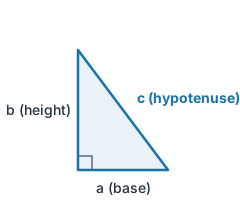
- a and b — the two legs, forming the right angle
- c — the hypotenuse, opposite the right angle
- c is always the longest side
| Missing side | Formula | Operation |
|---|---|---|
| Hypotenuse (c) | c = √(a² + b²) | Add the squares |
| Leg (a) | a = √(c² − b²) | Subtract the squares |
| Leg (b) | b = √(c² − a²) | Subtract the squares |
Steps
- Label the sides. Find the hypotenuse first — it is opposite the right angle.
- Decide whether the missing side is the hypotenuse or a leg.
- Pick the matching formula from the table above.
- Square the two known values, then add or subtract as required.
- Take the square root to get your answer.
Case 1: Finding a Missing Leg
Example 1: Hypotenuse 10 cm, one leg 6 cm
The missing side is a leg, so subtract:
| Step | Value | Description |
|---|---|---|
| Step 1 | b = √(c² − a²) | Formula for a missing leg |
| Step 2 | b = √(10² − 6²) | Put in the values you know |
| Step 3 | b = √(100 − 36) | Work out the squares |
| Step 4 | b = √64 | Subtract |
| Step 5 | b = 8 cm | Take the square root |
The missing leg is 8 cm.
Example 2: Hypotenuse 13 m, one leg 5 m
Again the missing side is a leg:
| Step | Value | Description |
|---|---|---|
| Step 1 | a = √(c² − b²) | Formula for a missing leg |
| Step 2 | a = √(13² − 5²) | Put in the values you know |
| Step 3 | a = √(169 − 25) | Work out the squares |
| Step 4 | a = √144 | Subtract |
| Step 5 | a = 12 m | Take the square root |
The missing leg is 12 m.
Case 2: Finding the Missing Hypotenuse
Example 3: Legs 9 cm and 12 cm
The missing side is the hypotenuse, so add:
| Step | Value | Description |
|---|---|---|
| Step 1 | c = √(a² + b²) | Formula for a missing hypotenuse |
| Step 2 | c = √(9² + 12²) | Put in the values you know |
| Step 3 | c = √(81 + 144) | Work out the squares |
| Step 4 | c = √225 | Add |
| Step 5 | c = 15 cm | Take the square root |
The hypotenuse is 15 cm.
Full detail on this case, including decimal answers, is in how to find the hypotenuse of a right triangle.
A Real-Life Problem
Example 4: The Ladder Problem
A 5 m ladder leans against a wall. Its foot is 3 m from the wall. How high up does it reach?
The ladder is the hypotenuse, the wall height is the missing leg:
| Step | Value | Description |
|---|---|---|
| Step 1 | b = √(c² − a²) | Wall height is a leg |
| Step 2 | b = √(5² − 3²) | Ladder 5 m, distance 3 m |
| Step 3 | b = √(25 − 9) | Work out the squares |
| Step 4 | b = √16 | Subtract |
| Step 5 | b = 4 m | Take the square root |
The ladder reaches 4 m up the wall.
Mistakes to Avoid
- Subtracting the wrong way round. Always take the smaller square away from the bigger one. A negative number under the root means you mixed up the hypotenuse.
- Adding when you should subtract. If a known side is the longest, you must subtract.
- Forgetting the square root at the end. b² = 64 is not the answer; b = 8 is.
- Mixed units. Convert everything to cm or m before starting.
Conclusion
Finding a missing side comes down to one decision: is the missing side the hypotenuse or a leg? Add the squares for a hypotenuse, subtract them for a leg, then take the square root either way. Check that the hypotenuse is still the longest side when you finish, and the answer will be right every time.