You already know the Pythagoras Theorem says a² + b² = c². But sometimes the three sides come out as nice whole numbers, with no decimals and no square root left over. These special number sets are called Pythagorean Triples. The most famous one is 3-4-5, and once you know a few of them, many triangle problems become almost instant. Let’s learn what they are and how to find them.
What is a Pythagorean Triple?
A Pythagorean Triple is a set of three positive whole numbers that fit the Pythagoras Theorem perfectly.
Three positive integers a, b and c form a Pythagorean Triple if a² + b² = c², where c is the largest number.
- Base (a) = 3
- Perpendicular (b) = 4
- Hypotenuse (c) = 5
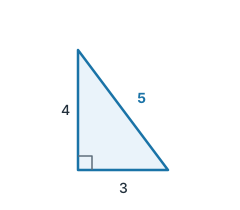
Check it: 3² + 4² = 9 + 16 = 25, and 5² = 25. Both sides match, so 3-4-5 is a triple. Any triangle built with these three lengths is automatically a right-angled triangle.
Common Pythagorean Triples
These are the ones worth memorising. If you spot two of the numbers in a question, you instantly know the third.
| a | b | c | Check (a² + b² = c²) |
|---|---|---|---|
| 3 | 4 | 5 | 9 + 16 = 25 |
| 5 | 12 | 13 | 25 + 144 = 169 |
| 8 | 15 | 17 | 64 + 225 = 289 |
| 7 | 24 | 25 | 49 + 576 = 625 |
| 20 | 21 | 29 | 400 + 441 = 841 |
| 9 | 40 | 41 | 81 + 1600 = 1681 |
| 12 | 35 | 37 | 144 + 1225 = 1369 |
Primitive and Non-Primitive Triples
If you multiply every number in a triple by the same value, you get another triple. The original is called primitive, and the multiples are non-primitive.
| Multiply 3-4-5 by | New triple | Type |
|---|---|---|
| 1 | 3, 4, 5 | Primitive |
| 2 | 6, 8, 10 | Non-primitive |
| 3 | 9, 12, 15 | Non-primitive |
| 10 | 30, 40, 50 | Non-primitive |
A triple is primitive when the three numbers share no common factor other than 1. All of these triangles have exactly the same shape — only the size changes.
How to Check if Three Numbers Form a Triple
Example: Is 8, 15, 17 a Pythagorean Triple?
Square the two smaller numbers and compare:
| Step | Value | Description |
|---|---|---|
| Step 1 | a² + b² = c² | Start with the theorem |
| Step 2 | 8² + 15² = 17² | Put in the three numbers |
| Step 3 | 64 + 225 = 289 | Work out the squares |
| Step 4 | 289 = 289 | Both sides are equal |
Yes — 8, 15, 17 is a Pythagorean Triple.
How to Generate Your Own Triples
There is a simple formula that produces triples endlessly. Pick any two whole numbers m and n where m is bigger than n:
a = m² − n² b = 2mn c = m² + n²
| m | n | a = m² − n² | b = 2mn | c = m² + n² | Triple |
|---|---|---|---|---|---|
| 2 | 1 | 3 | 4 | 5 | 3, 4, 5 |
| 3 | 2 | 5 | 12 | 13 | 5, 12, 13 |
| 4 | 1 | 15 | 8 | 17 | 8, 15, 17 |
| 4 | 3 | 7 | 24 | 25 | 7, 24, 25 |
| 5 | 2 | 21 | 20 | 29 | 20, 21, 29 |
Where Triples are Useful
- Exams: recognise 5-12-13 and you skip the square root entirely.
- Building: carpenters mark 3 ft and 4 ft along two edges — if the diagonal measures exactly 5 ft, the corner is a perfect right angle.
- Design and screens: whole-number triangles keep measurements clean with no rounding errors.
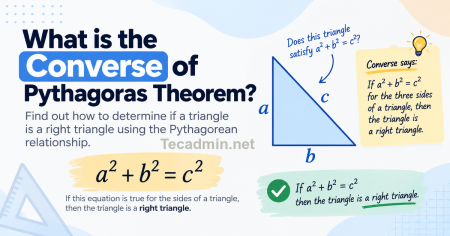
That construction trick works because of the converse of the Pythagoras Theorem, which lets you prove an angle is 90° just by measuring three sides.
Conclusion
Pythagorean Triples are simply whole-number answers to a² + b² = c². Memorise 3-4-5 and 5-12-13, remember that any multiple of a triple is also a triple, and use Euclid’s formula when you need fresh ones. They turn slow square-root calculations into instant answers, which is why they show up so often in exams and on building sites.